
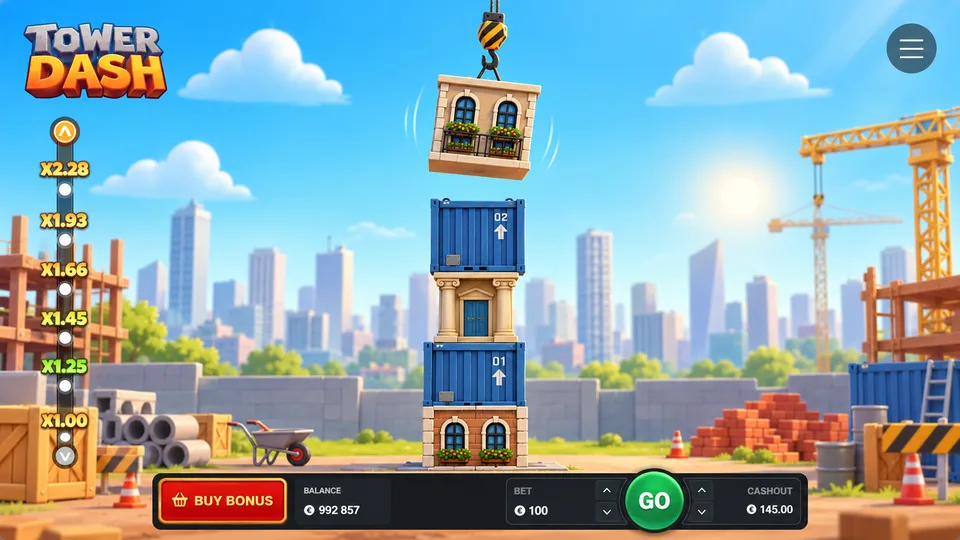
The Tower Dash game Nepal players find in online casino lobbies is a crash-style round from InOut Games: a crane swings blocks over a growing tower, and you decide when to stop. Every clean landing adds a floor and pushes the multiplier higher. One miss ends the round and takes the stake with it.
- difficulty levels
- 3
- Bonus Buy options
- 2
- RTP in game databases
- 96%
- listed maximum
- x10,000
- players only
- 18+
What Tower Dash Is and How It Feels to Play
Tower Dash takes the crash format, where a multiplier rises until something breaks, and turns it into a small construction job. Instead of watching a plane fly away or a line climb on a chart, you control the action yourself. The crane moves from side to side with a block hanging from its hook. You tap, the block falls, and it either lands on the tower or it does not.
That one change matters. In a classic crash round the timing of the crash is completely out of your hands and all you choose is the exit. In Tower Dash you also choose the moment of every drop, which makes each round feel more like a reflex game. The result of each drop is still decided by the game, so a steady hand helps the feel of the round far more than it helps the odds.
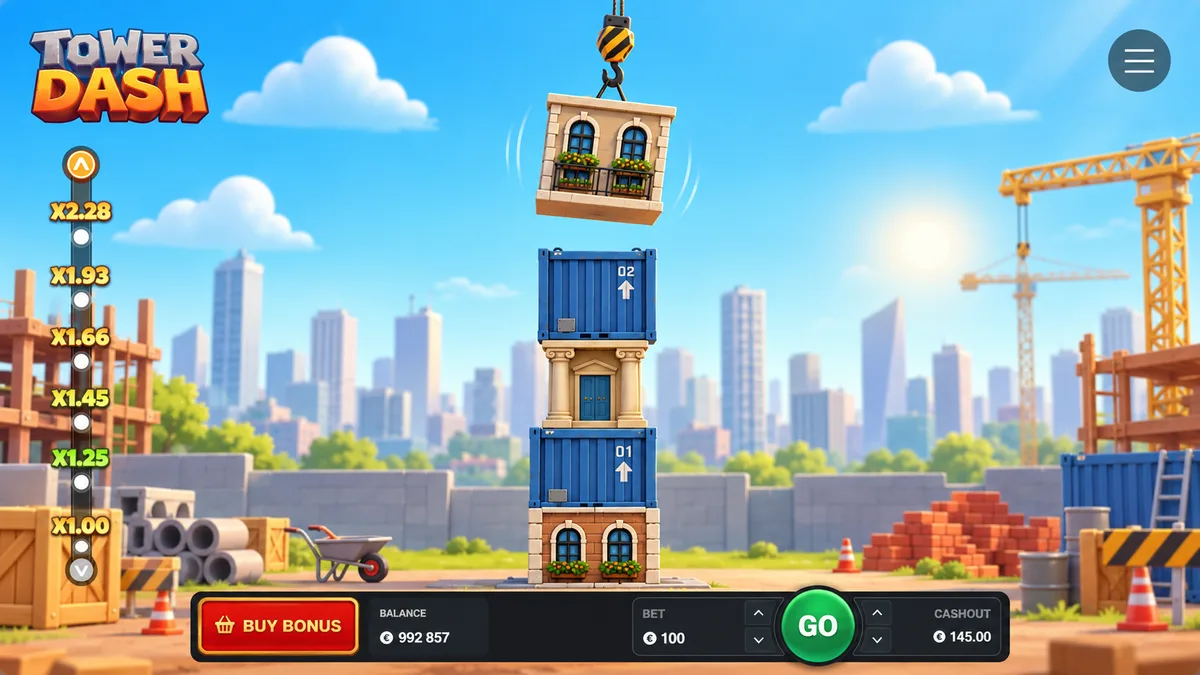
Between drops the cash-out button is open. Press it and the current multiplier is applied to your stake; the round closes with a win. Keep going and the next block appears on the hook. Short rounds, a clear picture of the risk and a single decision repeated again and again: that is the whole loop.
The game comes from InOut Games, a studio that builds quick casual titles for casino lobbies. On its own game page the provider offers two buttons, Demo Play and Play for real, which neatly mirrors the two ways most people meet the game in Nepal: first as a free trial, later with a deposit at a casino of their choice.
A Single Round From Stake to Cash-Out
Rounds are short. Once you have played two or three, the rhythm becomes obvious, and the sequence below never changes.
Set the stake
Choose the bet amount. Minimum and maximum bets are set by the casino, so they differ from one lobby to the next. A small example: Rs 50 per round.
Pick a difficulty level
Three levels are available. The higher you go, the more each round is shaped by risk. Check the in-game info if you want specifics, since InOut Games does not publish numbers for the levels.
Watch the crane and drop
The block swings above the tower. Tap to release it. A landing that holds adds a floor and lifts the multiplier one step.
Decide between drops
After each landing you can collect the current multiplier or ask for the next block. There is no automatic cash-out, so the tap is always yours.
Win or lose the round
Cash out and the stake times the multiplier goes to your balance. Miss a drop and the round ends, with the stake lost.
With Rs 50 on the line, a cash-out at x2 returns Rs 100 and a cash-out at x5 returns Rs 250. Those are illustrations of the arithmetic, not promises: the same rounds could just as easily end on the second or third floor.
Tower Dash Key Facts in One Table
Some details come straight from InOut Games, others only from third-party game databases, and several are simply not public. The table keeps those sources apart so you know how much weight each line can carry.
| Parameter | Value | Source |
|---|---|---|
| Developer | InOut Games | Provider game page |
| Game type | Crash-style round with a crane and a growing tower | Provider game page |
| Difficulty levels | 3 | Provider game page |
| Bonus Buy | Touch the Skies! and Build Your City! | Provider game page |
| Demo mode | Yes, Demo Play | Provider game page |
| RTP | 96% | Third-party game databases |
| Volatility | Medium to high | Third-party game databases |
| Maximum win | x10,000 | Third-party game databases |
| Auto cash-out | Not available | Third-party game databases |
| Bet limits | Set by each casino | Casino terms |
| Release date, developer RTP | Not published | Not public |
A 96% RTP is a long-run average across a huge number of rounds. It says nothing about your next ten drops. Medium-to-high volatility means results come in uneven waves: many short rounds, the occasional tall tower, and long stretches where the stake simply disappears.
Difficulty Levels and the Two Bonus Buy Modes
Tower Dash gives you two ways to change the shape of a session. The first is the difficulty level, picked before the round. The second is Bonus Buy, a paid shortcut into a special mode. Both are listed by InOut Games; their exact numbers are not.
Three difficulty levels
The gentlest of the three settings. It suits first sessions, demo practice and anyone who prefers longer runs with smaller steps between floors.
Even at the lower setting a single miss still ends the round. The level changes the pace, not the basic rule.
A balance between pace and risk. Many players settle on the middle setting once they understand how quickly a tower can fall.
A useful habit at this level is a fixed exit point, such as cashing out at x2 or x3, applied the same way every round.
The setting for players comfortable with sharper swings. Each round carries more risk per step, so sessions can end fast.
Smaller stakes make sense at this level, because a budget burns through quickly when several rounds stop on the first floors.
The provider does not publish names, multiplier tables or odds for the levels. Any site quoting precise figures is guessing. The game's own info panel at your casino is the place to check what each setting does.
Two Bonus Buy options
A mode with three attempts. The point is forgiveness: when a drop fails, your progress is kept instead of the tower being wiped.
It softens the harshest rule of the base game for a limited number of tries, which makes it the calmer of the two options.
A free-spins mode in which towers are built automatically. You do not time the drops; the game builds for you.
The more towers get completed, the higher the total multiplier and the final win. Think of it as a city that grows block by block on its own.
What Sets Tower Dash Apart From Other Crash Rounds
Crash games share a basic idea, yet they differ in how the round feels. These are the traits that give Tower Dash its own character.
You time the drops
Each block falls when you tap. The round moves at your pace rather than on a fixed timer.
Cash-out between every drop
There is a clear decision point after each landing, so you are never forced to react in a split second.
Three risk settings
Three difficulty levels let you choose between a slower climb and a sharper one before the round starts.
Two paid modes
Touch the Skies! and Build Your City! offer two different ways to skip straight to a special round.
Free demo
Demo Play runs on virtual credits, so the rules and the rhythm can be learned without spending rupees.
Built for phones
The game loads in a mobile browser or a casino app. One tap per drop works well on a small screen.
The visual side is simple on purpose. A city skyline sits in the background, the crane occupies the upper part of the screen and the multiplier is always in view. Nothing distracts from the only two things that matter: the block on the hook and the number next to it.
Demo Play and Real Money Side by Side
Most players start in demo mode, and that is a sensible first step. The rules are identical, so the demo teaches the timing, the levels and the feel of the cash-out button. What it cannot teach is how a real loss feels. That difference is worth respecting.
Demo Play
- Virtual credits, no deposit needed
- Same crane, same levels, same rules
- Good for testing exit points like x2 or x3
- No winnings can be withdrawn
- Available on the provider page and at many casinos
Real money
- Stakes in the casino account currency, rupees where offered
- Bet limits set by the casino
- Wins can be withdrawn under casino terms
- Losses are real, so a budget comes first
- Bonus Buy options cost real balance
A demo run of fifty or a hundred rounds says a lot about your own habits. Do you keep pressing for one more floor? Do you cash out too early and feel annoyed afterwards? Those patterns carry over to real play, and it is far cheaper to notice them with virtual credits.
InOut Games
Tower Dash is waiting in the casino lobby
Set a stake and a target multiplier before the first drop, and stick to both. 18+ only.

Playing Tower Dash From Nepal
Tower Dash is not a Nepali product, and no Nepali company runs it. Players in Nepal reach it through international online casinos that carry InOut Games titles. That shapes almost every practical detail, from currency to customer support.
Currency comes first. Some casinos let you keep an account in Nepalese rupees, so a stake reads as Rs 100 or NPR 100 and wins arrive in the same unit. Others use a different currency, and then every deposit and withdrawal passes through a conversion. That is worth checking before you register anywhere, because conversion costs quietly eat into small wins.
Payments are handled by the casino as well. Depending on the operator, the options can include bank transfers and local e-wallets. The game itself has nothing to do with them. Processing times, minimum amounts and verification steps all come from the casino's cashier and its terms.
Connection matters less than people expect. Rounds are light, the screen holds few moving parts and a stable mobile signal is usually enough. What matters more is the delay between your tap and the drop on a weak connection, so a calm Wi-Fi line is pleasant when you play at higher levels.
Language is rarely a barrier. The game screen relies on numbers and a single button, so English menus are easy to follow, and casino support teams usually answer in English. Account questions, bonus terms and payment issues always go to the casino, since InOut Games does not deal with players directly.
One practical point is easy to overlook. Withdrawal rules differ from casino to casino, and account verification often asks for documents. Sorting that out early, before any withdrawal request, saves a lot of waiting later.
Strong Sides and Weak Spots
No game suits everyone. The split below shows what works in Tower Dash and what may put you off.
What works
- Simple rules you can learn in a couple of rounds
- You decide the timing of every drop
- A cash-out window after each landing
- Three difficulty levels for different risk appetites
- Two Bonus Buy modes with very different styles
- Free demo with the same rules
What to weigh
- No auto cash-out, so every exit is manual
- Medium to high volatility according to third-party data
- A single missed drop burns the whole stake
- The developer publishes no RTP or level figures
- Bonus Buy price is not disclosed in advance
The lack of auto cash-out deserves a second look. In many crash games you can set an exit at, say, x2 and let the system collect. In Tower Dash there is no such button, according to third-party game listings. That puts discipline entirely on you, and it is the main reason a rule written down before the session works better than a decision made mid-round.
Mistakes That Cost New Players the Most
The most expensive errors in Tower Dash have nothing to do with timing. They come from decisions made before or between rounds, when the head is hot and the balance is moving. The same few patterns show up again and again.
Chasing a lost round is the classic one. A tower falls at x4 when you planned to leave at x3, and the next stake doubles to win it back. Two or three rounds later the budget for the evening is gone. Keeping the stake flat after a loss sounds boring. It works.
Moving the target mid-round comes second. You decide on x2, the tower reaches x2 and suddenly x3 looks close. Sometimes it is. Over a long session, though, a target you keep pushing up is no target at all, and the rounds that collapse at the last floor cost far more than the extra floors bring in.
The third pattern is skipping the demo. The crane has a rhythm, the levels feel different and the cash-out button sits in a specific spot. Learning all of that with real rupees on the line is a slow and costly way to study a game that is free to try.
Finally, many players start at the higher difficulty because the bigger steps look attractive. A short trial at the lower and middle levels first gives a much better sense of how fast a balance can shrink, and how long a session can last at each setting.
How to Think About Cash-Outs
No pattern, tool or timing trick changes the outcome of a drop. Each round is random. What you control is the size of the stake, the level you pick and the multiplier at which you leave. Everything sensible about Tower Dash strategy comes down to those three choices.
A fixed target is the simplest approach. Pick a number such as x2, cash out every time you reach it and accept the rounds that end before. A rising target suits players who want an occasional tall tower: most rounds end with an early exit, a few are allowed to run further. Neither method beats the house edge. They just make your results easier to read and your budget easier to manage.
Budget is the other half. Decide how many rupees the session is worth before you open the game and divide that by the stake. With Rs 1,000 and a Rs 20 stake you have fifty rounds of room, which is plenty for a relaxed session and a clear sign of when to stop.
Explore Every Tower Dash Topic
Everything above is the short version. Each topic below has its own page with more depth, worked examples and tools such as budget calculators, so you can go straight to the part that interests you.
Free practice
The Tower Dash demo page explains where Demo Play is found, how to use virtual credits to test exit points and what the demo cannot tell you about real sessions.
Phones and apps
On the Tower Dash app page you will find how the game runs on Android and iPhone browsers, how to add a home-screen shortcut and why unknown APK files deserve suspicion.
Rules in detail
The how to play Tower Dash page breaks down the screen, the three difficulty levels and both Bonus Buy modes, from the first drop to the final cash-out.
Playing with rupees
The Tower Dash real money page walks through deposits, rounds, cash-outs and withdrawals, with a payout calculator and a plain explanation of how casino bonus wagering works.
Budget and timing
The Tower Dash strategy page compares cash-out approaches, includes a bankroll calculator and explains why predictors and hacks are fiction.
A close relative
Tower Dash vs Tower Rush sets the InOut Games title against Tower Rush by Galaxsys, released in 2024 with a listed maximum of x100, and its 2026 sequel. The comparison covers features, RTP figures and which style suits which player.
Tower Dash runs in casino lobbies on phones and desktops alike. Start small, set your exit and play for fun. 18+ only.